Increasing Entropy #6
Discoveries of the week, death of SEO, world models, slop, some links, and a few thoughts on random topics.
AI is killing All About Berlin and cuts clicks to websites by 40%.
It is sad that quality websites lose visitors and audience. I love the small web, I love personal websites and blogs.
However, I think Google adds AI Overviews to search not because it’s evil, but because users want it and actually like it. I’m also one of those who go to AI first to ask a question or do research. Agents replace not only search for me, but also a lot of web apps I used before.
I use Kagi which shows an AI summary only when you request it explicitly by ending the query with a question mark. I would be curious to see statistics, but I think I ask for an AI reply in more than 90% of cases.
AI will continue to transform the way we work with information and I think it’s good. Humans have enormous agency for improving the world and inventing new things. As Tim Berners-Lee invented the World Wide Web, we’ll invent something new and I’m so curious what it will look like. What would be the place of search in the new world?
* * *
I haven’t used Google Search for more than 2 years and was surprised to learn how bad the search results look with ads and AI Overviews on top of search results:
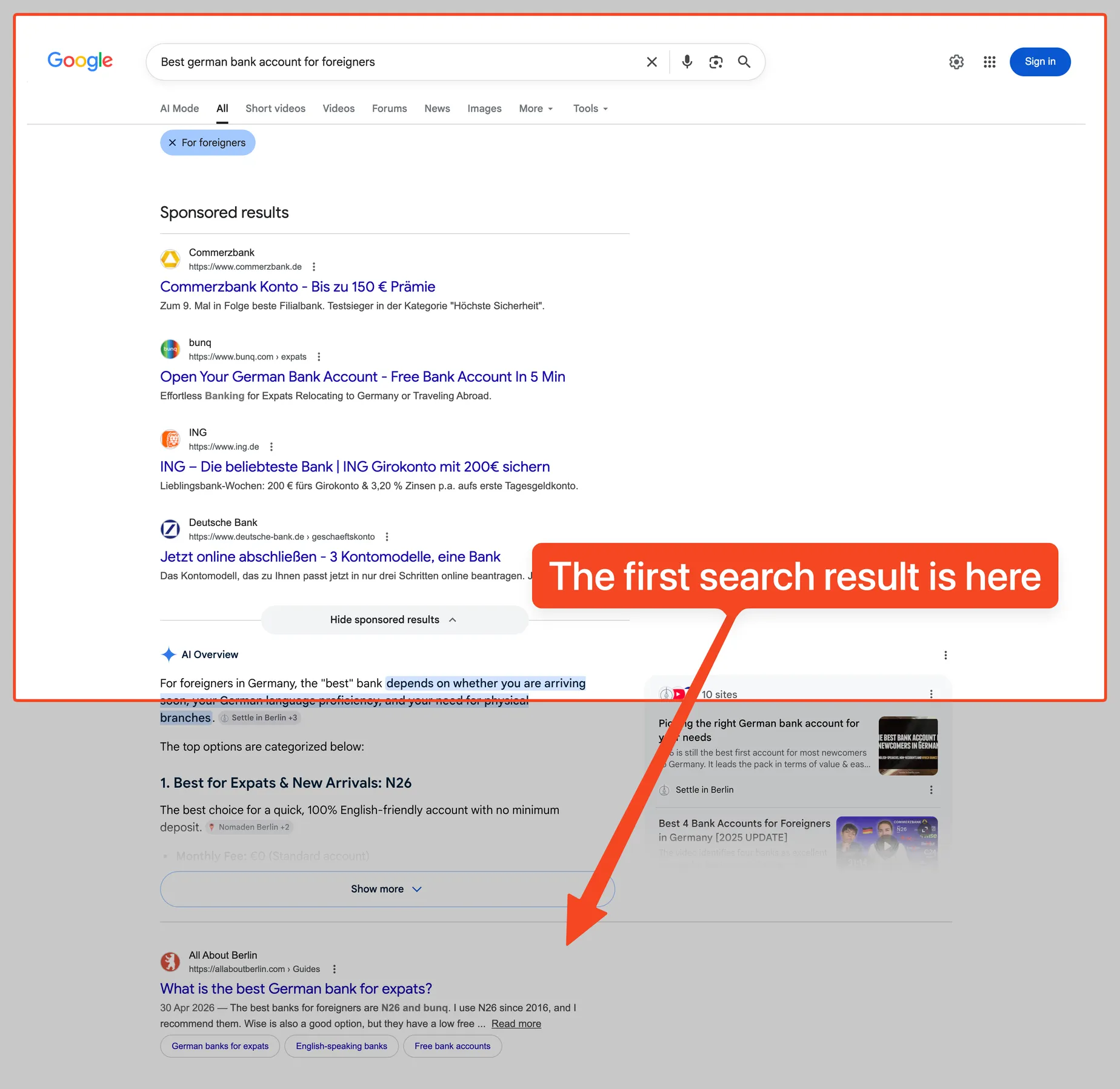
Screenshot from the AI is killing All About Berlin article
To be honest, I tried the same query, but Google doesn’t show me sponsored results for some reason.
* * *
I was explaining the concept of malleable software to a friend this week. I think there’s a great overview in Malleable software by Ink & Switch and a good take by the creator of Fibery in Malleable software = solid bases + custom code.
Claude Code released Code Mode. There’s a great explanation by Armin Ronacher: What is Codemode.
Web Browser Engineering walks you through building a tiny browser from scratch.
* * *
FLIP Fluid on Flip Dots. A beautifully documented hardware project. See the photos, or better, watch the video.
Restoring my Fiat 126 BIS, a not-yet-finished story with pictures by Herman Õunapuu.
* * *
All Code Is Slop (Except Mine), a 17-minute presentation by Lauren Tan. She says that if you add more automatic checkers and verification skills, eventually you begin to trust AI more and it speeds up your process of building and shipping code. An important point is that AI tends to replicate patterns in the existing codebase, so we should fight hacks and lazy workarounds from the beginning.
No AI Slop Manifesto says that sometimes automatic checks are not enough and we may want to slow down to understand and fix the system.
In Hands on the wheel, Ryan Bigg advocates for verifying the results of AI agents.
* * *
Genie 4 is out. I recommend watching the demo videos.
It’s impressive that the output is so consistent and resilient to changes of “camera” angle and subsequent prompting. You might think that to do this, the model would need to create some kind of 3D scene and fiddle with objects inside it, but that’s not the case at all. The model just generates video, frame by frame.
It’s a pity that it’s only possible to play with Genie with Google’s AI Ultra plan at the moment.
Coincidentally, this week I’ve stumbled upon an article about the joint-embedding predictive architecture: After 600 experiments, here’s what I discovered about JEPA world models. This is another approach to modeling the world, developed and advocated for by Yann LeCun, an alternative to predicting the world in pixels, as Genie 4 does.
There’s a good explanation of the difference between the approaches in Genie 4, explained: what world models are, and why Google keeps chasing them.