Increasing Entropy #1
Discoveries of the week, random links, and a bit of my thoughts on random topics
When prompted to act like a professional, models often switch vocabulary without actually switching methods. To work on our problem with depth, we need to use the same tools as the best data scientists and statisticians. When Claude reaches for markdown tables, insist on the use of databases and statistical models. You don’t necessarily have to know what the experts use, Claude usually does.
And other techniques from Felix Rieseberg in “How to be more ambitious: A tutorial for humans with models”.
Every once in a while I catch myself thinking “AI can’t do this” or “it would be too hard to explain the whole context” for whatever reason. One of the latest examples was when my wife, not a software engineer, wanted to give access to Google Search Console to an AI agent to analyze data to improve her business website.
Apparently, there’s no CLI and no MCP by Google. When I learned this, I thought: “I don’t want to even explain why it would be so hard to get the data for the agent”. The solution I had in mind was to create a project in Google Cloud, enable the necessary API in the project, set up auth for the agent, provide good prompts, and more. Nightmare, I thought.
It turned out the agent broke down everything into steps and provided her with instructions on how to do everything step by step. She had the connection in half an hour and has since been enjoying the power of AI when it comes to data analysis.
Knowing technical things could slow us down and we just have to re-evaluate our estimates in the modern world.
* * *
“We’ll have more software than we’ve ever had, but most of the code for it won’t have been written or even read by humans. […] It’ll be the end of programming.” — Paul Dix, creator of InfluxDB, in “The end of programming”.
Paul argues that the current generation of models (well, the post is from August so he speaks about Fable 5 and Astra) already are able to write software and verify it end to end. I think the consensus in the optimistic part of the industry is that as long as we give tools and provide ways for models to verify their own work — they perform incredibly well.
Personally, I somewhat struggle with the amount of work required for setting up everything on greenfield projects: test environment with good examples (examples matter a lot), mutation testing setup, linters, good prompts. However, I think it’s a temporary struggle (in the sense that models will get better and will solve this) that also doesn’t matter that much for projects past their bootstrap stage.
* * *
Turns out, passkeys have features such as “copyable”, “transferable”, and others. They could even be “attested” which means that an authenticating server could verify the exact software you use for managing passkeys, and not only the passkey manager but also an OS or firmware.
There is a lot of pessimism in “Passkeys are a trap. Do not use them.”, but it’s good to know more about passkeys.
* * *
Meta released a bunch of models: Muse Wonder, Muse Wonder Full. Benchmarks in the press release show high scores but Alexandr Wang, the Chief AI Officer at Meta admits that it’s not as good as Opus 5.5. Benchmaxxing?
People claim it’s SOTA and Meta AI is getting up to speed with Anthropic and OpenAI. I would love to try Wonder Full for coding, but it is not available via an API and only accessible in Muse Code. Which is a pity.
Also, Spark Open, 816B, 42B active parameters.
* * *
Jev 1.14 dropped with image support and the ability to select regions on uploaded images with a new “box” question type. The context or state limit now is 262k. The responses are as fast as the ones without images.
It couldn’t find Wally (or Waldo) though. The closest attempt is this:
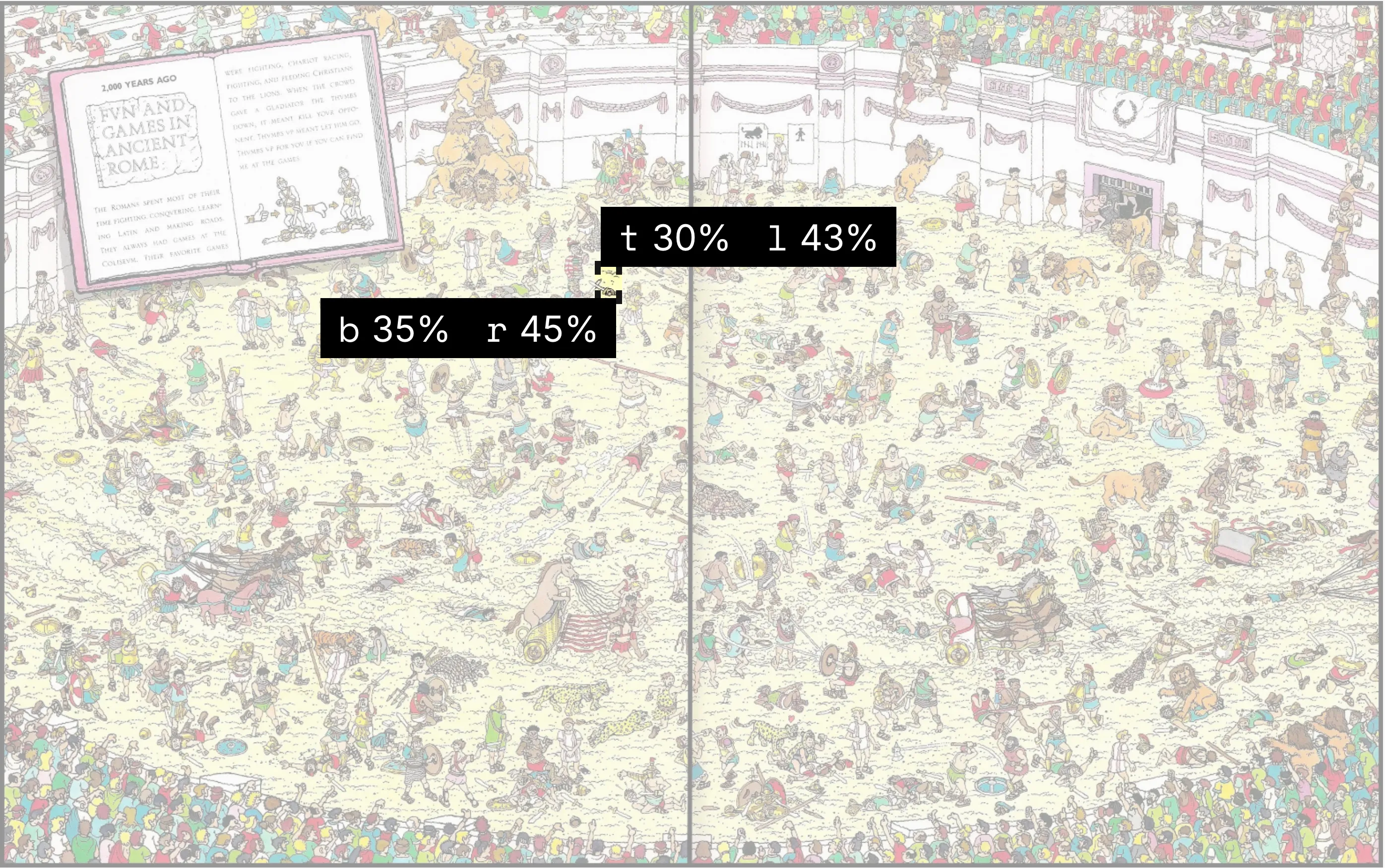
Looks like off by one error. I wonder if it’s a precision error since the coordinates are given as percentage offsets from the edges.
* * *
I like beautiful things and beautiful design. I think I spent an unreasonable number of hours on Piccsy when it was a thing. I believe I might still have a collection of pictures from it somewhere in archives on my disk. Houzz and Pinterest are almost as addictive for me as Instagram reels.
You can imagine how happy I was to discover more beautiful things:
- 23rd.dev — a small collection of beautiful components,
- recent.design — examples of graphical and web design for inspiration.